



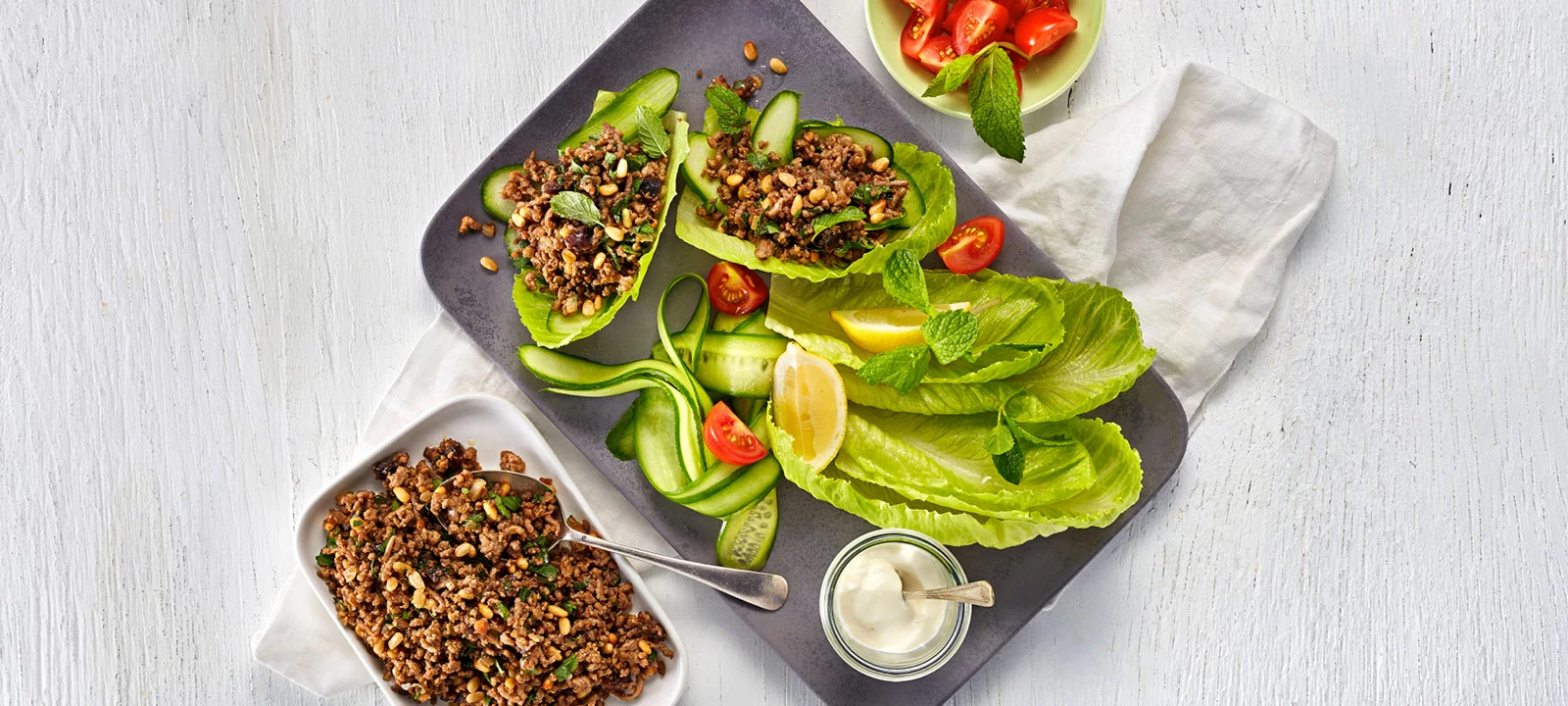
Spiced Lamb in Lettuce Cups
Preparation 20 Minutes
Cook 8 Minutes
Serves 4
Method
- Heat oil in a large frying pan. Add onion and garlic, cooking for several minutes until tender. Add spices, cooking a further minute. Increase heat and add lamb mince, cooking until well browned.
- Add dates, pomegranate molasses, herbs and pinenuts. Mix well and season to taste.
- Spoon mixture between prepared lettuce cups. Drizzle with yoghurt and lemon juice, finishing with additional mint leaves.
Ingredients
1 tbsp olive oil
1 small onion, finely diced
2 cloves garlic, finely chopped
1 tsp ground cumin
½ tsp ground coriander
¼ tsp ground cinnamon
500g lamb mince
6 ANGAS PARK Dates, finely chopped
1 tsp pomegranate molasses
½ cup parsley leaves, chopped
¼ cup mint leaves, chopped
¼ cup SUNBEAM Pinenuts, toasted
Baby cos lettuce leaves, cucumber ribbons, cherry tomatoes, natural yoghurt, lemon juice and additional mint leaves, for serving
Recipe Collection

Baked Brie with Fruit & Nuts
Soak dried fruit in maple syrup & hot water to coat for 15–20 mins until plump and sticky. The longer the soak the plumper the fruit gets.
Score the top of the brie (light cross-hatch), place on a baking dish or lined tray. Bake at 180°C for 10 mins, until soft and gooey.
Top with the soaked fruit mixture and a little extra maple syrup.
Serve warm with crusty bread & crackers
Mini Choc Raisin & Hazelnut Puddings
- Preheat oven to 170ºC. Place raisins, sultanas and rum in a bowl and set to one side.
- Cream butter and brown sugar, until light and fluffy.
- Beat in eggs one at a time beating well after each addition.
- Sift flours, mixed spice and cinnamon.
- Add breadcrumbs, finely chopped hazelnuts, chocolate, buttermilk, rum soaked fruit and butter mixture and mix well to combine.
- Prepare 8 pudding basins (200ml capacity): spray pudding basins with oil and line the bottom with baking paper.
- Divide evenly between prepared pudding basins.
Steaming Instructions
Place basins into a baking dish, and pour in enough boiling water to ½ fill the baking dish, cover with foil. Steam bake for 1 hour. Remove foil and bake for a further 20 minutes.
Microwave Instructions
Cook in microwave on defrost setting (300W) for 15 minutes, check if a skewer inserted into pudding comes out clean. If not cooked, microwave at 5 minute intervals, until skewer comes out clean. Stand for 10 minutes before turning out. Repeat with remaining mixture. (Note: Do not use foil in microwave).
Apple, Pear & Sunmuscat Filo Tart
Preheat oven to 200ºC (fan forced 180ºC). Line a baking tray with baking paper.
Combine all nuts, sunmuscats, breadcrumbs and cinnamon, toss to combine then drizzle over the maple syrup and mix well. Reserve 1/3 cup of this mixture.
Lay 1 sheet of filo onto prepared tray. Brush evenly with melted butter, sprinkle over ¼ of the nut mixture. Brush a second sheet with butter and arrange on top, repeat with another ¼ of the nut mixture. Repeat twice more, so you have 4 layers of brushed filo and nut mixture, then brush remaining filo sheet with butter and place on top.
Arrange apple and pear slices on top, brush with remaining butter then sprinkle over reserved nut mixture and coconut sugar.
Bake for 25-30 mins until pastry is golden. Cut into slices and serve with rocket.
Pumpkin Fruit Cake
Preheat oven to 160⁰C. Grease and line a 20cm round cake tin.
- Bring to the boil mixed fruit, sugar, syrup, butter and apricot nectar, stirring all the time and simmer gently for 10 minutes. Remove from heat and add bicarbonate of soda. Allow mixture to cool.
- Add eggs and pumpkin. Beat till smooth. Then add flours and mix well to combine.
- Place in tin and bake for 90 minutes, or until a skewer inserted into the cake comes out clean.
Self-Saucing Chocolate Pudding
- Pre-heat oven to 180°C (160°C fan-forced). Lightly grease a 4 cup capacity baking dish.
- Combine flour, almond meal, sugar and cocoa in a large mixing bowl.
- In a separate bowl, whisk together the butter, eggs and milk. Add to the dry ingredients with the raisins and mix well. Spoon into baking dish.
- For the sauce, combine the water, sugar and cocoa. Pour over the batter in the baking dish and bake for 30-35 minutes until cake is cooked. Serve warm with ice-cream, cream or custard.
Roast Pork with Pistachio Stuffing
Pat the pork belly dry with a paper towel, then score the rind at 1cm intervals.
To make the Pistachio Stuffing, melt the butter in a medium saucepan over low-medium heat. Add the shallot, lemongrass, garlic, ginger and chilli flakes. Cook, stirring for 3-4 minutes until softened. Then add the remaining ingredients. And cook, stirring, until pistachios are lightly golden. Remove from the heat and allow to cool. Then stir in the lemon zest and parsley leaves.
Butterfly the pork belly, leaving one edge intact. Spoon the Pistachio Cranberry Stuffing inside the pork and then roll up. Secure the pork with kitchen twine. Place pork into the fridge overnight (or for 12 hours) to allow the skin to dry up and the pork meat to take on the stuffing flavour.
Preheat the oven to 180℃ fan force.
Place pork onto a wire rack and into a roasting tin. Rub the oil over the pork belly skin and sprinkle over salt. Place into the middle of the oven and roast for 30 minutes. Turn heat down to 160℃ and continue to cook for 2 hours to slowly cook the pork meat. Then, to finish, turn the oven up to the highest grill setting and continue cooking for 2-4 minutes until skin has turned to crackling – you may need to use tongs to rotate the pork a few times to brown all sides evenly.
Remove from the oven and allow to rest for 10 minutes, before carving.