



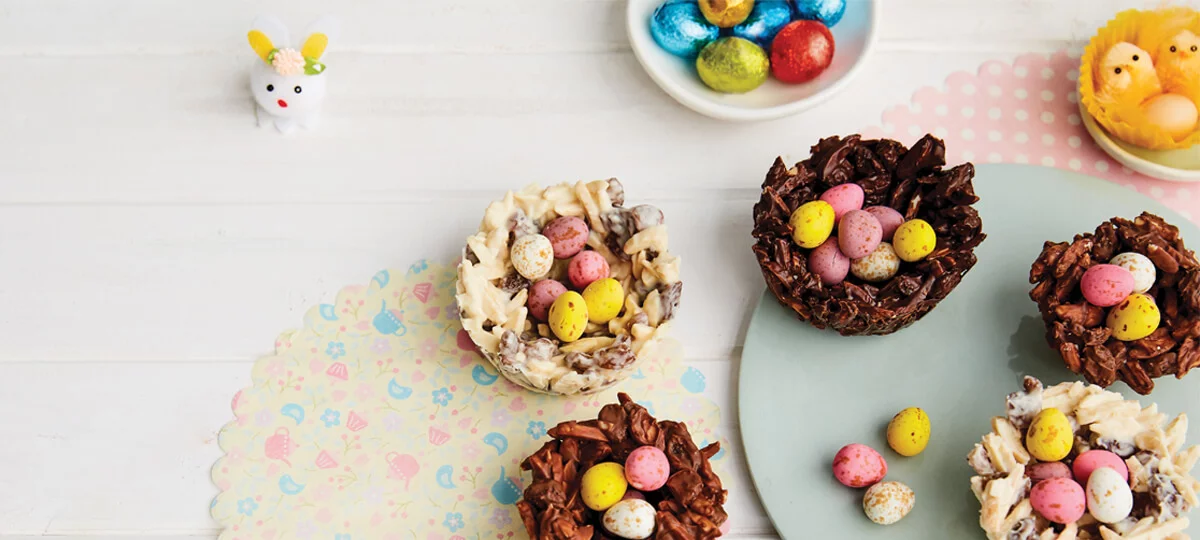
Easter Chocolate Nests
Preparation 10 Minutes
Cook 10 Minutes
Serves 10
Method
Preheat oven to 180°C.
Line a baking tray with baking paper and spread out almonds on top of it. Bake for 8 minutes or until light golden in colour. Remove from tray and cool.
Lightly grease a patty pan tray.
Combine ingredients together in a bowl. Place spoonfuls into tray and shape into a nest using the back of a spoon. Refrigerate until set. Decorate with Easter eggs.
Ingredients
165g Sunbeam Slivered Almonds
170g Sunbeam Sultanas, coarsely chopped
220g Milk Chocolate, melted
Easter eggs for decorating
Recipe Collection

Pine nut, Sultana & Maple Tart
Place the maple syrup, sugar, and salt in a medium saucepan and stir to combine them. Add the butter, place the saucepan over med-high heat, and bring mixture to a boil, stirring often. Remove the saucepan from the heat and transfer the mixture to a large mixing bowl; add the sultanas & allow it to cool for 20 minutes. Whisk in heavy cream, followed by the egg and egg yolk.
Preheat the oven to 180 Degrees.
Place the tart shell on a baking sheet to catch any drips. Distribute the pine nuts evenly over the bottom of the tart shell and pour the custard into the shell until it reaches the top of the crust. Bake for 30-45 minutes, or until both the crust and the filling have turned light golden brown and the custard is set but still jiggly.
Serve the tart while still slightly warm, or cool it and serve at room temperature. Leftovers will keep, wrapped in plastic, for a few days in the refrigerator.
Christmas, Dinner, Entertaining, Lunch, Recipes, Savoury, Special Occasions
Preheat the oven to 180°C. Place the pumpkin halves, cut-side up, on a baking tray. Brush the cut side with 1 tbs oil. Roast for 1 1/4 hours or until just tender. Set aside to cool.
Use a spoon to remove pumpkin seeds and membrane and discard. Meanwhile, arrange the walnuts & hazelnuts on a baking tray and roast for 3-5 mins or until toasted. Set aside to cool. Coarsely chop
Heat the remaining 1 tbs oil in a large frying pan over medium heat. Add the onion and cook, stirring, for 4 mins or until softened. Add the garlic and cook, stirring, for 30 secs or until aromatic. Stir in the mushrooms & lemon thyme.
Place the onion mixture, breadcrumbs, egg, fetta, baby spinach, currants and nuts in a large bowl and stir to combine. Season.
Divide mixture among pumpkin shells and press down firmly. Carefully place the pumpkin shells together and tie with kitchen string to secure. Place on a baking tray and roast for 45 mins or until heated through. Transfer to a serving platter.
Fruit & Nut Log Salami
In a dry pan on medium heat gently toast the slithered almonds till slightly brown, then set aside to cool.
Place the finely chopped dates and apricots pistachios, ginger & biscuits in a bowl.
Add the almonds, currants, cranberries Blend until well mixed, add melted chocolate & condensed milk and stir till combined.
Turn out onto cling film. Roll and shape into a log. Chill for at least 4 hours.
To decorate tie with bakers string roll in powdered sugar and wrap in baking paper.
Roasted Peach Parfait with Gingerbread Granola
For the granola
Preheat the oven to 180℃.
In a large bowl, add all of the ingredients and mix well with a wooden spoon until all well combined.
Spread the mixture across 2 large baking trays lined with baking paper. Place into the oven and bake for 20-25 minutes, tossing the granola after 10 minutes.
Remove from the oven and allow granola to cool completely before storing in airtight containers, or jars.
Notes
Granola will store in an airtight container or jar for up to 2 weeks.
For the Peaches
Preheat the oven to 180℃.
Place peach quarters into a baking dish, sprinkle over the coconut sugar, ginger and drizzle over the vanilla and lemon juice. Toss gently, then place into the oven for 15 minutes, or until just tender.
Meanwhile, make the Mascarpone Cream. Place the cream into a stand mixer and whip for until fluffy and stiff peaks form. Add the mascarpone and whip again until combined. Add in the sugar and whip again.
To assemble Parfaits, layer the Marscapone Cream and Roasted Peaches. Garnish with the Gingerbread Granola and coconut flakes. Repeat for another layer.
Panforte
-
Pre-heat oven to 180°C (160°C fan-forced). Line the base and sides of a 20cm round cake pan.
Place sugar, honey and chocolate in a large saucepan and gently heat until chocolate is melted. Stir in the raisins, figs, cherries, cranberries and nuts. Mix well.
Add flour, cocoa and spices to mixture and working quickly mix it together until all combined. You may need to wear a thick rubber glove. Press mixture into prepared pan and bake for 13-15 minutes. Set aside to cool before removing from pan to cool completely.
Almond Star Bread
Preheat the oven to 180℃.
To make the Spiced Almond Cream: place butter and sugar into a stand mixer bowl. Mix for 2 minutes, until smooth. Slowly add the whisked eggs, salt and vanilla and mix again to incorporate. Fold in the almond meal and cinnamon and fold through with a wooden spoon to incorporate.
Slice each piece of puff pastry into 4 x 25cm circles.
Place one dough circle onto a piece of baking paper and spread 1 tablespoon of the Spiced Almond Cream evenly over the top. Stack the next dough circle on top and repeat with more Spiced Almond Cream. Repeat again with the final two dough circles.
Place a round object, about 7-8cm wide into the centre of the circle and make an indent, which becomes the centre of the star.
Cut the dough into 16 evenly spaced strips, starting from the indent to the edge of the dough. Take two strips next to each other and roll them away from each other. Press the two ends together to join. Repeat with the remaining 14 strips until each are twisted and paired up.
Transfer the star on the baking paper to a large baking tray. Brush with egg water wash and sprinkle over the flaked almonds. Place into the oven and bake for 25 minutes until puffed up and golden brown.
Remove from the oven, allow to cool and then dust with icing sugar, to serve.